Here we are, no one else
Time flies, Christmas ploughs on, words from the perfect soulmate, Rob Halford

December was so short.
As a child, the month used to drag on and on — a year’s length crammed into thirty-one days, all anticipation and sleepless nights. Christmas is coming… I just wish it would move a little bit faster.
These days, Christmas’s approach is like some phenomenal juggernaut, mercilessly ho-ho-hoing its way towards you like an Uber snowplough (seats up to seven; higher prices reflect size of vehicle, etc). As it shudders towards you, it brings a stack of consternation with it. The days after Christmas are alien in their own way, with TV news programmes presented by people you’ve never seen before. Those few days feel like hold music on a phone call. Time isn’t real now. Someone on the other end will pick up soon. Then the year’s done, gone. Bright days ahead, somewhere in the distance.
December has always been a fight between the 24/7 fun zone and actual, real tiredness. This year, add chemotherapy drugs that are slowly leaving the system, taking every ounce of energy out of you, balling it up and chucking it on the fire. Although I’m fine with that — whatever will be will be — it does become very tempting to stay in bed some days and do nothing, making the month a little bit shorter again.
These quick days have brought a fair amount of reflection with them. Having finished bunging down the poison pills on a daily basis, I’ve found myself thinking about the people undertaking these merciless climbs — ploughing through the peaks and troughs, the footholds and the foot-slips — on their own. Infinite technobabble meetings, and that impossibly bleak 7am walk from reception to surgery check-in, the sun trying to blink through the night with each footstep. Finding the energy to turn up for the fifth week of lasers to the brain, or trying to calm your own nerves as you’re plugged into the chemo-matrix for the fourth time.
The impossibility of it all, undertaken in the name of recovery.
As I’ve said before, I’ve been lucky. Through all of those seismic landmarks that stretched out in front of me after diagnosis — surgery, radiotherapy, chemotherapy — I had a hand to hold.
With no serious choice in the matter, my wife Leanor has been by my side for all of it: an advocate, a whip-crack, a guiding light, a listener, a shoulder. The perfect soulmate.
I might be the one who took a knife to the head — and lasers, and poison pills — but Leanor dealt with all the small points, the things I would miss or couldn’t find the brain space to manage. When I drifted through months in a half-speed haze — a demeanour part clown, part super-obliterated stoner — she kept the family going. And she kept me going, because there are days — many days — when you can’t be bothered to do a damn thing, whether in December or any other month.
Since June, I’ve written thoughts on all of this and published them on Scatterbrained. Talking to her last week, she said she was interested in getting her own thoughts down in some form, when she had a minute. So I thought: enough from me for the moment — why don’t I let her talk about how all of this has affected her?
Leanor and I chatted on a Wednesday morning just before the kids broke up from school. Some of her responses made me pause, each one a very different reaction to the situations I’ve been through — understandable, but always a little surprising to hear.
It’s also worth noting that if it sounds a little down, she was in good humour the whole way through. As I said earlier, she really has been the perfect hand to hold on days like these. So I thought I’d share her words here.
“The first Scatterbrained piece — where you came up to the office and told me about the call, that moment when our world fell apart — captured things perfectly. That’s now the story, even if it’s not exactly how it happened. Not that my version is radically different; it’s just that once something is written down, it quickly becomes fact.
“Last year was momentous, but really it’s part of a longer story that we’ve just had to get on with. Our life story, I suppose.
“I’ve spent a lot of time thinking about how I’d explain our situation to a stranger. Last year — and maybe the beginning of this year — that felt impossible. It became easier during chemotherapy, because chemo is such a recognised thing. Everyone knows it’s horrendous, which makes it strangely simple to explain: He’s doing chemo. People understand. Most people know someone who’s been through it, so there’s a shared frame of reference.
“Before that, it felt more like: how can I meet someone new and tell them this? Imagine being out for a drink, meeting a friend of a friend. They ask how you are and you say, Oh, my husband’s got a brain tumour. I’d end up apologising. Sorry — you asked me what I wanted to drink and I realise I’ve just dumped this massive thing on you. Trying to chat about flippant things when all this is going on in the background puts you off meeting new people. You retreat into the comfort of your own living room.
“I think of everything that’s happened as two distinct years. Last year, we found out and our world shattered. We spent the whole time trying to work out what to do. You booked the operation — the one I was terrified you wouldn’t come back from in a recognisable way. Thankfully, the surgery was incredibly successful, which was a massive relief.
“This year, I started thinking: how the fuck are we going to survive? The questions became practical. I knew you hadn’t disappeared, and I knew this treatment wasn’t going to make you disappear. The side effects you struggle with — the admin, the memory stuff — aren’t damage to your personality. I can live with those things. But the question that kept coming back was: what if you can’t work? What if you can’t earn money? How am I going to drive you to hospital every day and earn money? My job had just ended at the beginning of 2025, which played on my mind too. When radiotherapy started, I thought: how are we going to do this? How are we going to look after the kids, do the treatment, and survive financially?
“Somehow, we did. In many ways, it was because you kept going and kept working to some degree, and I didn’t have to carry everything alone.
“Radiotherapy ended up being a kind of high in how it affected you. It sounds strange now, but there was a sense of familiarity — even excitement — about going into the same rooms every day. You bonded with the people whose job it was to get you through it. With radiotherapy, you saw someone every day, and the extra support they gave meant it wasn’t just us dealing with the situation. There was routine. Those constant hospital visits weren’t pleasant, but the structure those people helped build meant the pressure wasn’t all on me.
“Seeing you so ill — watching you coming down, looking like you were dying — was really hard. Knowing you were being sick upstairs, trying to stay away from the kids so they wouldn’t get scared. At the points where you were really ill — vomiting all night in the bathroom, looking like you were fading — I found myself thinking: I can’t care about you being ill and do everything else. For my own sanity, I had to draw a line. You’re a grown man. You do you, and I’ll do everything else.
“Illness is isolating. We have lovely friends, but you realise that in situations like this you become an island. People don’t want to encroach — rightly — but that can leave you feeling alone, especially without family nearby. Friends will help if you ask, but that’s different from someone just turning up with dinner, or taking you to the pub when you clearly need a drink and someone to talk to. There’s a difference between someone saying I’ve got this and actually being the person who has to have it, all the time.
“And although the kids are on your side, you can’t say everything to them. You can’t say, This is really fucking hard. You have to soften it. That’s a lot. But we made it to the end of the year — the end of treatment — and that, in itself, is incredible.
“We spent countless hours in hospital meetings, but the one that stands out is when they talked about properly stopping chemo. That was the moment I thought: now I’m facing what the rest of our lives might look like. Being me, I went home and wrote a detailed five-year financial plan. Treatment teaches you to move one step at a time. You’re lucky, but it’s not you’re cured. My way of coping is practical: how do we live our best life now? How do we make sure we’re financially okay if something happens?
“One of the frustrating things about chemotherapy is that there’s no bell to ring. No clear ending to it. Radiotherapy was different — when you finished, you rang the hospital bell and everyone cheered. It was hope for you and for everyone else, all wrapped up in that simple gesture. Chemotherapy felt more solitary. And in some ways it felt like if we celebrate too much, we’ll jinx it. So we stay cautious. Tentative. And quietly grateful, for now.
“Finishing treatment means something is put behind you, even as you learn to live with uncertainty. Nobody knows how life will pan out; this just makes that impossible to ignore. I ask myself what the point is of lying awake worrying. Instead, I focus on what I can control — money, plans, setting ourselves up so we’re not trapped by debt.
“There’s no part of me that thinks this has been a good thing. But we made the best of it. I’ve never thought why us. These things have to happen to someone, and I’m deeply glad we got through it. Weirdly, I feel optimistic about the future. I don’t know why. We’ve been incredibly unlucky — but also strangely lucky at every turn: the timing, the surgery, the care. I hope that small streak of luck continues.
“I don’t think the year ends and recovery is complete and I’ve learned some grand lesson. But I do think we’re moving forward — more cautiously, probably in six-month chunks. I don’t plan far ahead anymore. I always want refundable tickets. That might sound paranoid, but it isn’t. It’s not like we won’t have fun. Some things will be tempered, but I still like being with you, and I really think we’ll have a good life.
“And I’m okay with that. That’s enough.”
A year in hindsight.
Beyond everything else that’s gone on this year, it’s worth reiterating the point that the NHS remains one of our greatest achievements as a country. A collective spirit for all of us, from the grace of the surgeon’s knife in to eventually – hopefully - talking it all out. Every meeting, every phone call, every conversation undertaken with sympathy and trust. A national religion.
This year, I was incapable of two hours of concentration so I missed pretty much any film that people told me I really had to see. I saw Thunderbolts* and Fantastic Four: First Steps in the flicks, and the Dylan film, which was hilarious and myself and my daughter were the youngest people in the cinema by decades (She’s 15, I’m 54). Recently, I’ve been watching badly ripped trailers for Avengers: Doomsday that someone’s stuck online – two minutes concentration seems about right.
On the telly, I’ve adored Gone Fishing, which feels like the tranquil cousin of Last One Laughing (also great, somehow). This is TV accepting and embracing its age, Caught by the River in an hour of rolling screentime. Elsewhere, The Chair Company, Severance, Pluribus and Slow Horses have all delivered their own strange, wonderful visions of people and places. Also, gunning Mick Herron’s Clown Town in a day or two means I’m now something like 5 series ahead of the TV version of Slow Horses.
Music wise, I’ve listened to so little thanks to the deafness in my left ear. Have loved Steven Wilson’s The Overview, the new Deftones LP, watching Charli xcx from a platform in front of the stage at Glastonbury (very very heavy sounding gig), Manic Street Preachers’ Critical Thinking (and their incredible show in Bristol four days after radiotherapy stopped) and I’ve been listening to Gravenhurst’s last album The Ghost in Daylight, which is more reminiscent of Talk Talk with every passing year (that might just be the listener’s ears though).
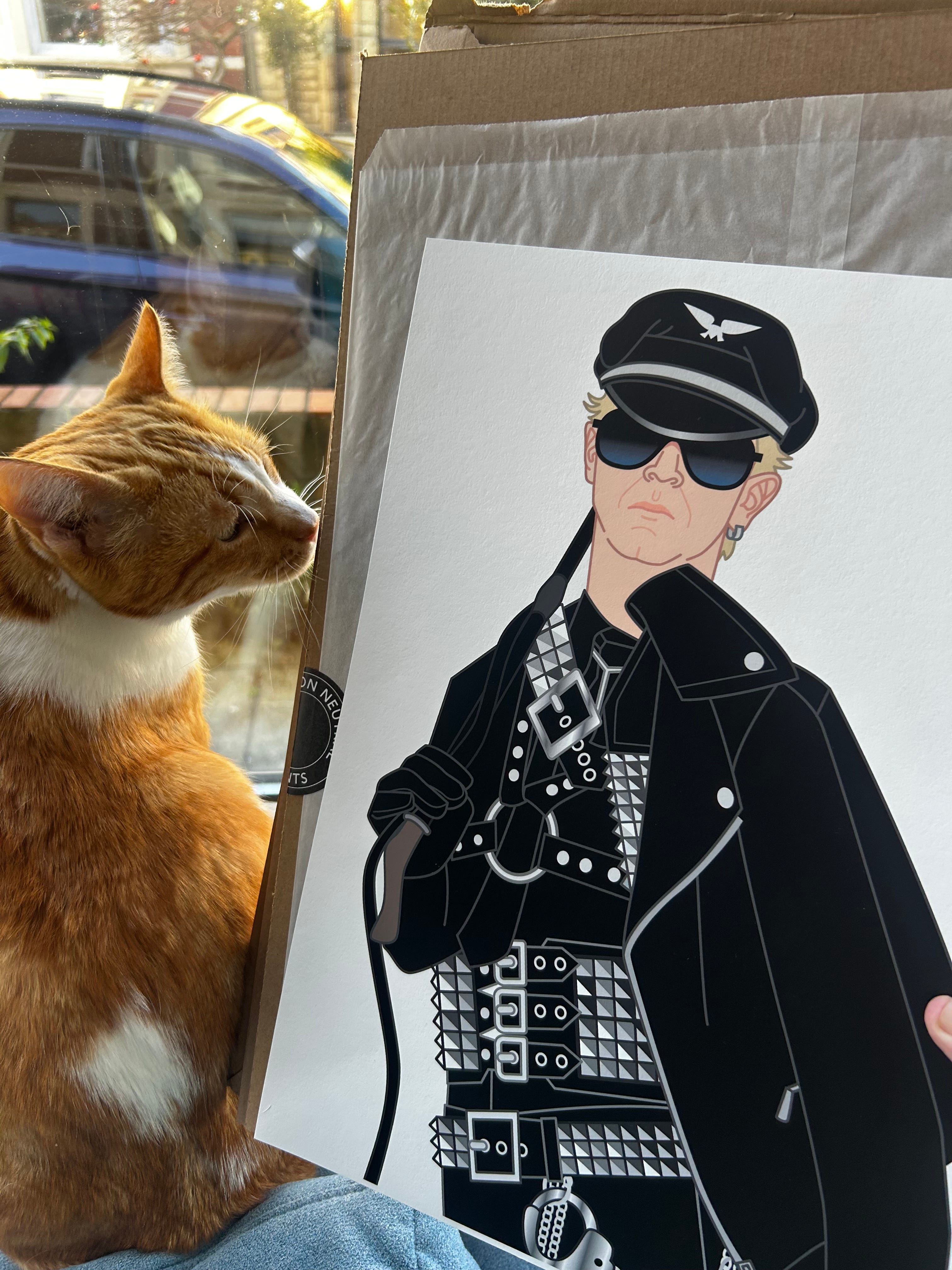
Minimal year, sorry it looks so bloody poor. Special nods to Lost and Grounded (Bristol’s greatest brewery) and Pazzo (Bristol’s greatest restaurant) and massive respect to artist and Welsh genius Pete Fowler, who sent me this picture of Rob Halford, inspired by the man’s action’s in this video.